Introducing Sentra’s End-to-End Data Security Platform

Most Complete Visibility including AI models

Most Accurate Classification

Most Scalable Performance

Most Operationally Cost Efficient

Three-tiered diagram representing data security layers: Use Cases with Secure & Responsible AI, Continuous Compliance, Cloud Data Loss Prevention; Comprehensive Protection with DSPM, Remediate, DDR, DSPM for AI, DAG; and Automated Classification with Discovery, Classification, Context, Labeling.

Complete Visibility for All Your Data – On-Prem and in the Cloud 

Full and automatic discovery
on IaaS, PaaS, SaaS and on-premise

No more insecure shadow data, unknown data, manual connections, blind spots, and disparate catalogs

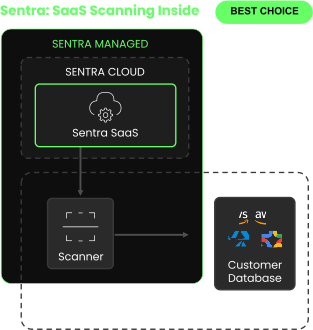
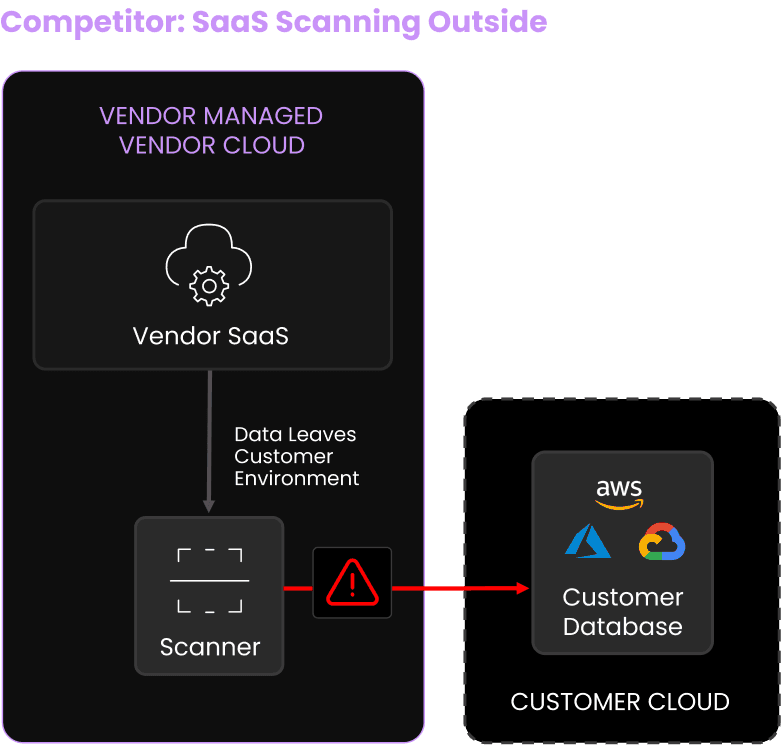
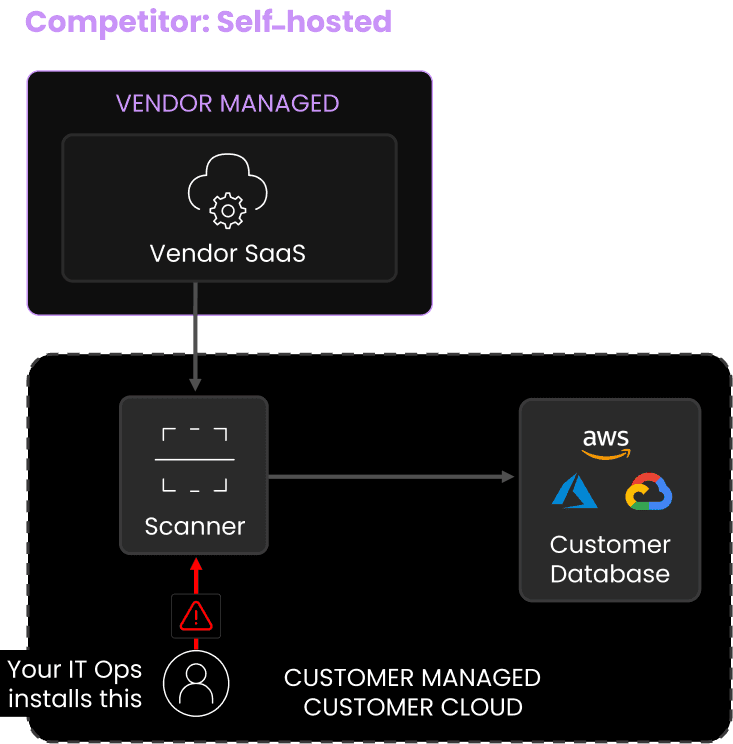
Data never leaves your environment
so it remains secure and compliant

Public Cloud Providers
AWS cloud logo alongside icons representing various AWS storage services including S3, EBS, EFS, FSx, and others.
Google Cloud logo followed by five hexagonal icons representing various cloud services including AI, analytics, database, computing, and storage.
Logos of popular database and cloud technologies including Azure, Redis, MongoDB, PostgreSQL, MySQL, Cosmos DB, SQL Server, and IBM Db2.
PaaS
Logos of Redis, MongoDB, Atlas, and Snowflake technologies.
SaaS
Icons of enterprise software platforms including Salesforce, ServiceNow, and Microsoft OneDrive.
On-Premises Databases
Logos of popular database technologies: Redshift, MySQL, PostgreSQL, MongoDB, Apache Cassandra, Apache Spark, and Elasticsearch arranged in two rows.
On-Premises File Shares
Logos of EMC, VMware, NetApp, Hewlett Packard Enterprise, and Windows Server.

AI Classifiers Provide Deep Business Context 

Discover and automatically classify your sensitive data (PII, PCI, PHI)

>95% Classification Accuracy across structured and unstructured data

Domain optimized to categorize department, geography, industry, ownership, sensitivity automatically

Diagram showing a central hub connected to various sectors: Finance, Sales, Healthcare, R&D, HR, Retail, Legal, Travel Tech, and Consumer, each linked by small icons resembling microchips.

“It evolves with our business — giving us confidence to safely integrate GenAI.”

Zachary Schulze, Sr. Staff Application Security Engineer, SoFi

Understand Data at Risk and Secure it — no matter where it travels!

Determine and prioritize exposure risk for all file types

Improve posture — enforce data security and compliance policies

Reduce data attack surfaces (ROT, shadow, AI)

Security Posture Score of 7.8 out of 10 marked as Good with a 30-day trend line rising slightly. Top risks include Business Continuity down 2% at 60M, Shadow Data up 2% at 20.1K, and Exposed Data steady at 0% with 10K.

Enforce Data Access Governance

Activate controls via integrations with IAM and DLP systems (revoke access, de-identify data, etc.)

Manage access issues such as excessive permissions, unauthorized access, support least privilege access control

Flag high-risk identities and proactively prevent access control risks

Diagram showing data access governance flow from AWS user Neil Pearth through Analytics to various access groups and resources, including a bucket named pineapple-qa with user count labels like 72K, 47K, and 89K.

Detect and Remediate Risk 

Respond in real-time with actions including revoke access, enforce policy, initiate workflow, mitigate behavior

Identify suspicious transfers or movement of sensitive data into unauthorized environments

Connect every data event to human, service, or machine identity to reveal anomalous access

Sentra Amplifies Your Data Security Effectiveness

Risk and Threat Mitigation

Capture data context to bolster sensitivity analysis and optimize CNAPP/CSPM/IR processes

Data Loss Prevention

Automatically tag sensitive data to empower DLP to stop exfiltration

Data Access Governance

Map identities to permissions and enforce least privilege data access

Data Governance

Enrich catalog integrity with complete inventory including unknown data

What Vendors Don’t Want You to Test

Your goal in running a data security/DSPM POV is to evaluate all important performance and cost parameters so you can make the best decision and avoid unpleasant surprises. Many vendors, on the other hand, look for a ‘quick win’ and will often suggest shortcuts like using a limited test data set and copying your data to their environment. Make sure your POV is without compromise.

POV Best Practices
1

Classify data in customer environment

2

Test coverage of different file formats

3

Test customization of policies and classification

4

Test real time monitoring (DDR)

5

Test scale and cloud cost efficiency

POV Worst Practices
1

Copy data to the vendor for the quick win

2

Limit features and capabilities

3

Limit size of scanned data

4

Restrict integrations to avoid “complications”

5

Limit the use of API