In today’s cloud-first, AI-driven world, one of the most persistent and underestimated risks is over-permissioned access. As organizations scale across multiple clouds, SaaS applications, and distributed teams, keeping tight control over who can access which data has become a foundational security challenge.
Over-permissioned access happens when users, applications, or services are allowed to do more than they actually need to perform their jobs. What can look like a small administrative shortcut quickly turns into a major exposure: it expands the attack surface, amplifies the blast radius of any compromised identity, and makes it harder for security teams to maintain compliance and visibility.
What Is Over-Permissioned Access?
Over-permissioned access means granting users, groups, or system components more privileges than they need to perform their tasks. This violates the core security principle of least privilege and creates an environment where a single compromised credential can unlock far more data and systems than intended.
The problem is rarely malicious at the outset. It often stems from:
Roles that are defined too broadly
Temporary access that is never revoked
Fast-moving projects where “just make it work” wins over “configure it correctly”
New AI tools that inherit existing over-permissioned access patterns
In this reality, one stolen password, API key, or token can potentially give an attacker a direct path to sensitive data stores, business-critical systems, and regulated information.
Excessive Permissions vs. Excessive Privileges
While often used interchangeably, there is an important distinction. Excessive permissions refer to access rights that exceed what is required for a specific task or role, while excessive privileges describe how those permissions accumulate over time through privilege creep, role changes, or outdated access that is never revoked. Together, they create a widening gap between actual business needs and effective access controls.
Why Are Excessive Permissions So Dangerous?
Excessive permissions are not just a theoretical concern; they have a measurable impact on risk and resilience:
Bigger breach impact - Once inside, attackers can move laterally across systems and exfiltrate data from multiple sources using a single over-permissioned identity.
Longer detection and recovery - Broad and unnecessary permissions make it harder to understand the true scope of an incident and to respond quickly.
Privilege creep over time - Temporary or project-based access becomes permanent, accumulating into a level of access that no longer reflects the user’s actual role.
Compliance and audit gaps - When there is no clear link between role, permissions, and data sensitivity, proving least privilege and regulatory alignment becomes difficult.
AI-driven data exposure - Employees and services with broad access can unintentionally feed confidential or regulated data into AI tools, creating new and hard-to-detect data leakage paths.
Not all damage stems from attackers - in AI-driven environments, accidental misuse can be just as costly.
Designing for Least Privilege, Not Convenience
The antidote to over-permissioned access is the principle of least privilege: every user, process, and application should receive only the precise permissions needed to perform their specific tasks - nothing more, nothing less.
Implementing least privilege effectively combines several practices:
Tight access controls - Use access policies that clearly define who can access what and under which conditions, following least privilege by design.
Role-based access control (RBAC) - Assign permissions to roles, not individuals, and ensure roles reflect actual job functions.
Continuous reviews, not one-time setup - Access needs evolve. Regular, automated reviews help identify unused permissions and misaligned roles before they turn into incidents.
Guardrails for AI access – As AI systems consume more enterprise data, permissions must be evaluated not just for humans, but also for services and automated processes accessing sensitive information.
Least privilege is not a one-off project; it is an ongoing discipline that must evolve alongside the business.
Containing Risk with Network Segmentation
Even with strong access controls, mistakes and misconfigurations will happen. Network segmentation provides an important second line of defense.
By dividing networks into isolated segments with tightly controlled access and monitoring, organizations can:
Limit lateral movement when a user or service is over-permissioned
Contain the blast radius of a breach to a specific environment or data zone
Enforce stricter controls around higher-sensitivity data
Segmentation helps ensure that a localized incident does not automatically become a company-wide crisis.
Securing Data Access with Sentra
As organizations move into 2026, over-permissioned access is intersecting with a new reality: sensitive data is increasingly accessed by both humans and AI-enabled systems. Traditional access management tools alone struggle to answer three fundamental questions at scale:
Where does our sensitive data actually live?
How is it moving across environments and services?
Who - human or machine - can access it right now?
Sentra addresses these challenges with a cloud-native data security platform that takes a data-centric approach to access governance, built for petabyte-scale environments and modern AI adoption.
By discovering and governing sensitive data inside your own environment, Sentra provides deep visibility into where sensitive data lives, how it moves, and which identities can access it.
Through continuous mapping of relationships between identities, permissions, data stores, and sensitive data, Sentra helps security teams identify over-permissioned access and remediate policy drift before it can be exploited.
By enforcing data-driven guardrails and eliminating shadow data and redundant, obsolete, or trivial (ROT) data, organizations can reduce their overall risk exposure and typically lower cloud storage costs by around 20%.
Treat Access Management as a Continuous Practice
Managing over-permissioned access is one of the most critical challenges in modern cybersecurity. As cloud adoption, remote work, and AI integration accelerate, organizations that treat access management as a static, one-time project take on unnecessary risk.
A modern approach combines:
Least privilege by default
Regular, automated access reviews
Network segmentation for containment
Data-centric platforms that provide visibility and control at scale
By operationalizing these principles and grounding access decisions in data, organizations can significantly reduce their attack surface and better protect the information that matters most.
Lior is a Product Manager at Sentra, focused on building practical data security products for cloud and SaaS environments. Previously, she was a Technical Product Manager at Lendbuzz, leading product strategy and execution for core payments and infrastructure systems, and working closely with engineering on complex systems. Before that, Lior spent several years at Talenya (a Paycor company), where she grew from Software Developer to R&D Team Leader, gaining hands-on experience building and scaling production systems. Earlier in her career, she worked as a DevOps Engineer and Full Stack Developer. Lior holds a BA in Computer Science and brings a strong engineering mindset to product management.
Subscribe
Latest Blog Posts
Mark Kiley
April 1, 2026
5 Minutes
Min Read
HIPAA + North Carolina Identity Theft Protection Act: A Data Security Guide for Hospitals and Health Systems
HIPAA + North Carolina Identity Theft Protection Act: A Data Security Guide for Hospitals and Health Systems
Quick refresher: HIPAA Breach Notification Rule
Under HIPAA, a breach is “the acquisition, access, use, or disclosure of unsecured PHI in a manner not permitted” by the Privacy Rule, unless a documented risk assessment shows a low probability that the PHI has been compromised.
Key HIPAA breach notification requirements (at a high level):
To affected individuals: Without unreasonable delay and no later than 60 days after discovery
To HHS (OCR):
For breaches affecting 500+ individuals in a state: contemporaneously with individual notice
For smaller breaches: annually, within 60 days of the end of the calendar year
To the media: For breaches affecting 500+ residents of a state or jurisdiction
HIPAA is focused specifically on PHI, information related to an individual’s health status, provision of care, or payment for care that can identify the individual.
North Carolina’s Identity Theft Protection Act for healthcare
North Carolina’s Identity Theft Protection Act requires any business that owns or licenses NC residents’ personal information, including hospitals and health systems, to notify affected individuals, and in many cases the Attorney General and consumer reporting agencies, after security breaches involving “personal information.”
What counts as “personal information” in NC
The Act defines “personal information” as a person’s first name or first initial and last name plus any one of several sensitive data elements, when not encrypted or redacted. For healthcare providers, that can include:
Social Security numbers (often present in registration and billing)
Driver’s license or state ID numbers
Financial account or payment card numbers with any required codes or passwords
Health insurance policy numbers or other unique identifiers used by a health insurer
Biometric data and other identifiers that can be used to access financial accounts or uniquely identify an individual
Crucially, NC “personal information” is not limited to PHI. It picks up employee PII, guarantor or subscriber information, and login credentials for portals and billing systems that might fall outside HIPAA’s PHI definition.
What NC considers a “security breach”
A “security breach” under N.C. Gen. Stat. § 75‑65 means unauthorized access to and acquisition of unencrypted and unredacted data containing personal information where illegal use has occurred or is reasonably likely to occur, or that creates a material risk of harm to a consumer.
Good‑faith access by an employee or agent is not a breach, as long as the information is used only for legitimate purposes and not further disclosed.
Encrypted data generally does not trigger notice unless the keys or process to decrypt are also compromised.
The NC Department of Justice offers additional guidance and emphasizes prompt notice and risk‑based assessment of harm:
HIPAA vs. NC Identity Theft Protection Act: Where they overlap and differ
For hospitals and health systems, HIPAA and NC law often apply at the same time—but they do not cover exactly the same datasets or impose identical obligations.
When both laws apply
Both HIPAA and NC law will typically apply when:
PHI of North Carolina residents is exposed in a way that meets each law’s definition of “breach” or “security breach”; and
The data is unsecured (e.g., unencrypted PHI or keys compromised) and there is a realistic risk of misuse.
In these scenarios, you’ll need to:
Conduct a HIPAA risk assessment of compromise
Assess material risk of harm under NC law
Issue timely notices that satisfy both HIPAA and NC content/timing requirements
Because HIPAA allows up to 60 days, while NC expects notice “without unreasonable delay” after discovery (subject to law enforcement delay and scoping needs), the stricter timeline will often be driven by your ability to determine the scope of affected NC residents and data types.
Where NC reaches further than HIPAA
NC’s Identity Theft Protection Act covers several scenarios HIPAA alone might not fully address:
Employee and non‑patient PII
Employee payroll and HR records, including SSNs, DL numbers, and bank information
Volunteer and contractor data used for background checks or credentialing
Patient‑adjacent financial and identity data
Guarantor and subscriber information that may be outside your designated record set
Payment card and bank data tied to hospital billing systems
Credentials and portal access
Patient portal usernames and passwords
Staff credentials or MFA secrets that can be used to access systems containing PI or PHI
Non‑PHI systems still holding NC personal information
Legacy billing, call center, or marketing platforms
Shadow IT and SaaS apps adopted by specific departments
Where HIPAA may focus your teams on clinical systems and PHI, NC law forces you to widen the lens to all personal information you hold about NC residents—across clinical, financial, HR, and digital engagement ecosystems.
Practical implications for NC hospitals and health systems
Taken together, HIPAA and NC breach law create three core operational challenges:
You must know where NC residents’ PHI and PII actually live
EHR and core clinical systems are just the start.
PHI and NC “personal information” frequently spill into:
Data warehouses and analytics platforms
Imaging archives, document management, and fax servers
Email, file‑sharing, and collaboration tools (e.g., M365, Google Workspace)
AI‑related logs and training data (chatbots, scribes, coding assistants)
You must be able to rapidly scope “who was affected and how"
For NC residents specifically, you need to answer:
Which datasets in the compromised environment held NC‑defined personal information?
Were those data encrypted, masked, or tokenized—and were the keys safe?
How many distinct NC residents were affected and what types of data were involved (PHI vs financial vs credentials)?
You must manage multiple, overlapping clocks and audiences
HIPAA’s 60‑day clock
NC’s “without unreasonable delay” expectation for residents and the Attorney General
Potential media and CRA notifications (HIPAA for large breaches; NC for >1,000 individuals via credit bureaus)
Without a unified, data‑centric view, most health systems are left stitching together EHR logs, DLP alerts, and manual exports to approximate impact—burning precious weeks while both clocks are running.
Why DSPM is becoming foundational for HIPAA + NC compliance
Data Security Posture Management (DSPM) is emerging as the foundation for modern healthcare data security because it focuses on what HIPAA and NC regulators ultimately care about: what sensitive data you have, where it lives, how it’s protected, and who can get to it.
A mature DSPM platform should enable hospitals and health systems to:
1. Continuously discover and classify PHI + NC personal information
Agentless connections into cloud storage, data warehouses, M365, and SaaS, as well as on‑prem file shares and databases.
2. Map effective access and exposure, not just where data sits
Understand who actually has access to PHI and NC personal information—including clinicians, back‑office staff, vendors, and AI agents—across all environments.
Highlight over‑permissioned roles, stale accounts, and risky sharing patterns that increase breach scope before incidents occur.
4. Proactively shrink breach impact before it happens
Finally, DSPM isn’t just for incident response. For NC hospitals, it should support:
Data minimization: Identifying redundant or obsolete PHI and PII, especially in analytics sandboxes, exports, and backups
Stronger encryption coverage: Ensuring sensitive records are encrypted at rest and in transit, with keys managed in line with both HIPAA security and NC expectations around encryption and “unusable” data.
Least‑privilege access: Systematically tightening access to sensitive datasets—particularly those combining PHI and NC‑defined personal information—so any single incident affects fewer people.
A unified playbook for HIPAA and North Carolina breach readiness
For NC hospitals and health systems, a pragmatic approach looks like this:
Inventory your regulated data universe
PHI (HIPAA) and NC‑defined personal information across clinical, financial, HR, and digital systems.
Deploy continuous DSPM across cloud, SaaS, and on‑prem
Move from point‑in‑time questionnaires and manual spreadsheets to always‑on discovery and classification.
Align your HIPAA risk assessment and NC “material harm” criteria
Use shared evidence (classification, encryption posture, access analytics) to drive consistent decisions.
Update incident response plans to include NC‑specific steps
Explicit branches for: notifying NC residents, the NC Attorney General, and relevant consumer reporting agencies.
Run joint table‑tops (HIPAA + NC)
Simulate a multi‑system breach impacting NC residents and walk through every step from detection to notification.
Measure and improve over time
Track metrics like “time to scope affected datasets” and “time to identify affected NC residents” as core readiness KPIs.
By embedding a data‑centric security posture—supported by DSPM—into daily operations, NC hospitals can turn overlapping HIPAA and state obligations from a scramble into a repeatable, defensible process.
See how leading health systems are unifying HIPAA and NC breach readiness with DSPM.
Get a live walkthrough of how Sentra discovers PHI and NC‑defined personal information across EHR, cloud, and SaaS—and how it accelerates incident scoping and notification.
Sentra MCP Server: AI-Driven Data Security Operations
Sentra MCP Server: AI-Driven Data Security Operations
The Gap Between Seeing and Doing
Data Security Posture Management has delivered on its promise of visibility. Organizations know where their sensitive data lives, which stores are misconfigured, and how many identities can reach their crown jewels. But a fundamental gap remains: the distance between seeing a security problem and resolving it is still measured in manual steps, context switches, and tribal knowledge.
Security teams spend disproportionate time on operational toil -- navigating dashboards, correlating data across screens, constructing API queries, and manually updating alert statuses. Every alert triage requires the same sequence of clicks. Every compliance audit requires the same series of exports. Every access review requires the same chain of lookups.
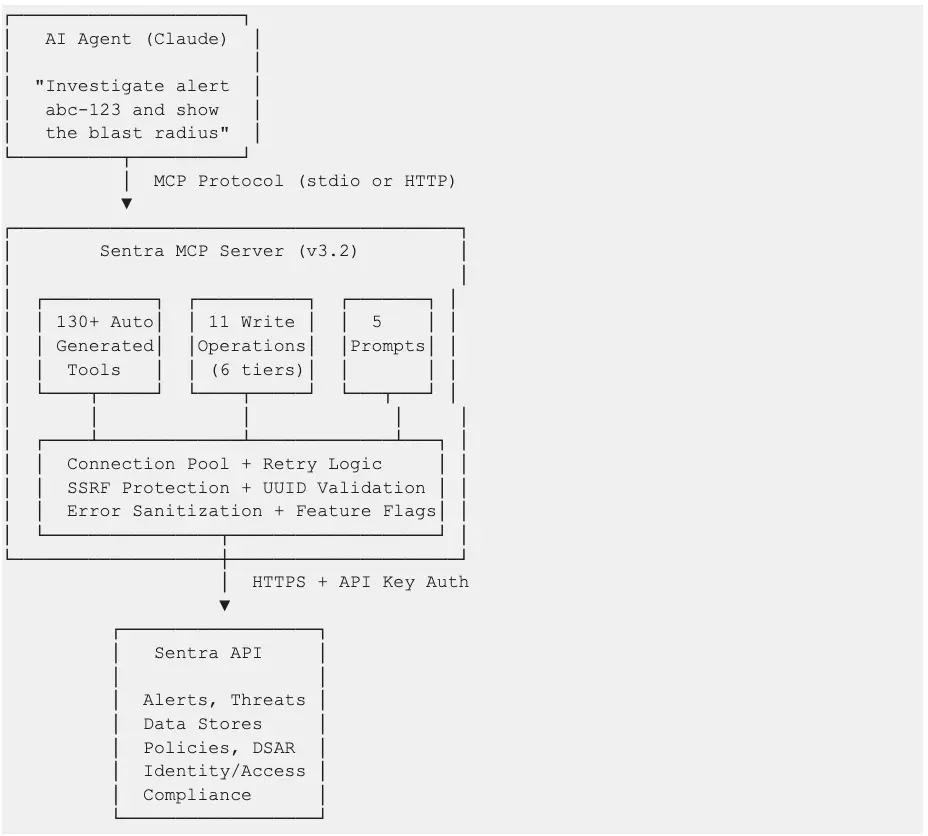
The Sentra MCP Server closes this gap by exposing the full breadth and depth of the Sentra platform through the Model Context Protocol (MCP), an open standard that enables AI agents to discover and call tools programmatically. This turns every security operation -- from a simple status check to a multi-step investigation with remediation -- into a natural language conversation.
Unlike read-only MCP implementations that provide a conversational interface to data catalogs, the Sentra MCP Server is a complete security operations platform. It reads, investigates, correlates, and acts. It chains multiple API calls into coherent workflows. And it does so with enterprise-grade safety controls that put security teams in command of what the AI agent can do.
Core thesis: AI-driven DSPM doesn't just tell you what's wrong -- it investigates, triages, and helps you fix it.
How It Works
The Sentra MCP Server sits between AI agents (Claude Desktop, Claude Code, Cursor, or any MCP-compatible client) and the Sentra API, translating natural language requests into precise API call chains.
Architecture highlights:
Auto-generated tools: The MCP server parses Sentra's OpenAPI specification at startup and dynamically creates tool wrappers using closures with inspect.Signature -- no code generation or exec() required. This means new API endpoints are automatically exposed as tools when the spec is updated.
Unified request pipeline: All tools -- read and write -- flow through a shared HTTP client with connection pooling, automatic retry with exponential backoff for rate limits (429) and server errors (5xx), and consistent error handling.
Safety-first write operations: Write tools are organized into a 6-tier hierarchy from additive-only to destructive, gated behind a feature flag, with UUID validation and explicit safety confirmations for high-risk operations.
Capability Deep Dive
Read Operations by Domain
The Sentra MCP Server exposes read operations across every domain of the Sentra platform:
Domain
Tool Count
Example Operations
Alerts
~20
List alerts, filter by severity/status, get trends, compliance aggregation, risk ratings, affected assets
Threats
~5
List threats, filter by MITRE tactic, get threat details
Data Stores
~20
Inventory stores, filter by type/region/sensitivity, aggregated risk, scan status, top data classes
Data Assets
~10
Search assets, count by type, export, file extensions, classification findings
Data Insights & Classes
~15
Data class distribution, group by account/region/store type/environment, dictionary values
Identity & Access
~15
Search/count identities, accessible stores/assets, full access graphs, permission metadata
Connectors
~5
List connectors, filter by type, associated connectors
Policies
~5
List policies, filter, incident counts
Compliance
~5
Framework compliance aggregation, control mappings, security ratings, rating trends
List DSAR requests, request details, download reports
AI Assets
~2
List AI/ML assets, asset details
Dashboard & Sensitivity
~3
Dashboard summary, sensitivity overview, scan status
Every tool includes enhanced descriptions that guide the AI agent on when to use it, what parameters to pass, how to construct filters, and what follow-up tools to chain for deeper investigation.
Write Operations: The 6-Tier Hierarchy
Write operations are the key differentiator. They transform the MCP server from a query interface into an operations platform. Each tier represents increasing impact and corresponding safety controls:
All 11 write tools are gated by the SENTRA_ENABLE_WRITE_OPS environment variable (default: enabled). Setting it to false completely removes all write tools from the MCP server, leaving a read-only interface.
Why this matters: Read-only MCP servers can tell you "this policy generates 200 low-severity alerts." The Sentra MCP Server can tell you that and then disable the policy and resolve its alerts -- in the same conversation.
Composite Investigation Tools
Two composite tools chain multiple API calls into single-invocation investigations:
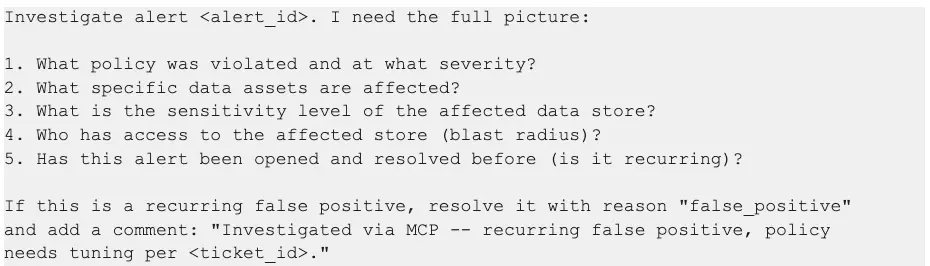
`investigate_alert(alert_id)` -- Full alert triage in one call:
These tools reduce what would be 5-6 sequential API calls into a single invocation, dramatically reducing latency and context window usage for the AI agent.
Guided Workflow Prompts
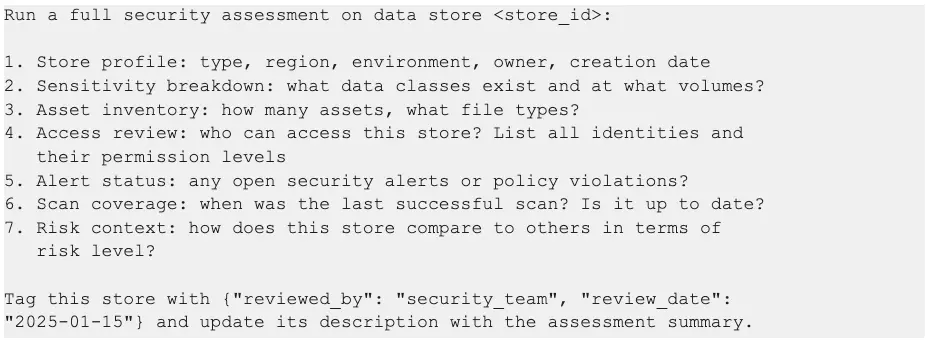
Five MCP prompts provide pre-built, step-by-step instructions that guide the AI agent through complex security workflows:
5-step identity deep dive: details, accessible stores, accessible assets, access graph, related threats
investigate_data_store
store_id
7-step store assessment: details, sensitivity, asset count, access list, alerts, scan status, data classes
Prompts serve as expert runbooks encoded directly into the MCP server. A junior security analyst using these prompts follows the same investigation methodology as a senior engineer.
Use Cases
UC1: Quick Security Status Check
Persona: Security operations analyst starting their shift
Prompt:
"Show me all open alerts by severity and our current security rating."
Value: Instant situational awareness. No dashboard navigation, no login sequence. A 2-second question replaces a 5-minute morning routine.
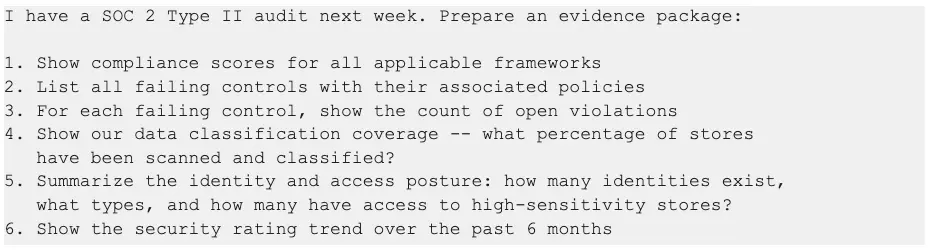
UC2: Compliance Readiness Assessment
Persona: GRC analyst preparing for an upcoming HIPAA audit
Prompt:
"Prepare HIPAA compliance evidence: show our compliance score, all HIPAA-related controls and their status, any open violations, and data classification coverage for PHI across all data stores."
Value: Audit preparation that typically takes a full day compressed into a single conversational session. The output is structured for direct inclusion in audit evidence packages.
UC3: Alert Triage and Resolution
Persona: Security engineer responding to an overnight alert
Prompt:
"Investigate alert 7a3f9c21-4b8e-4d2a-9f1c-8e7d6a5b4c3d. Walk me through what happened, what data is at risk, who can access it, and whether this has happened before. If it's a false positive, resolve it and add a comment explaining why."
Value: End-to-end triage and resolution in one conversation. The composite tool gathers all context in a single call, and write operations close the loop -- no need to switch to the Sentra UI.
UC4: Identity Access Review
Persona: Security architect conducting a quarterly access review
Prompt:
"Show me all external identities with access to high-sensitivity data stores. For the identity with the broadest access, map the full access graph from identity to roles to stores to assets. Flag any stores with open alerts."
Tools used: search_identities (filtered), get_data_access_identities_by_id_accessible_stores, get_data_access_identities_by_id_graph, alerts_get_all_external (filtered per store)
Value: Access reviews that require correlating identity data, store sensitivity, role chains, and alert status -- all unified into a single investigation flow. The graph traversal reveals access paths that flat permission reports miss.
UC5: Policy Noise Reduction (Hero Example)
Persona: Security operations lead tuning policy configurations
Prompt:
"Audit all enabled security policies. For each, show how many open alerts it generates and its severity. Identify policies generating more than 50 low-severity alerts -- those are candidates for tuning. For the noisiest policy, show me sample violated assets so I can verify if it's misconfigured. Then disable that policy and resolve its existing alerts as false positives."
Tools used:
policies_get_all -- Retrieve all enabled policies
policies_get_policy_incidents_count -- Alert counts per policy
alerts_get_all_external -- Alerts filtered to the noisiest policy
policy_change_status -- Disable the misconfigured policy (write)
alert_transition -- Resolve existing alerts as false positives (write)
Value: This is the workflow that defines the difference between observing and operating. A read-only MCP server stops at step 4. Sentra's MCP server completes the full audit-to-remediation cycle, reducing policy noise that would otherwise consume analyst hours every week.
UC6: M&A Data Security Due Diligence
Persona: CISO assessing an acquisition target's data security posture
Prompt:
"We're acquiring Company X. Their AWS connector is 'companyX-aws-prod'. Give me a full data security due diligence report: all data stores in that account, sensitivity levels, open alerts and threats, access permissions, and compliance gaps. Flag anything that would be a deal risk."
Value: M&A due diligence that would require a dedicated workstream compressed into a structured assessment. The connector-scoped view ensures the analysis is precisely bounded to the acquisition target's infrastructure.
UC7: Board-Ready Security Briefing
Persona: CISO preparing for a quarterly board presentation
Prompt:
"Prepare my quarterly board security briefing: security rating trend over 90 days, current compliance status by framework, open alerts by severity with quarter-over-quarter comparison, data-at-risk trends, sensitivity summary, and top 5 prioritized recommendations."
Value: Board materials that tell a story: where we were, where we are, what we've improved, and what we need to prioritize next. The AI agent synthesizes data from 6+ tools into a narrative suitable for non-technical audiences.
UC8: AI Data Risk Assessment
Persona: AI governance lead assessing training data risk
Prompt:
"Show me all AI-related assets Sentra has discovered. For each, what sensitive data classes are present, who has access to the training data stores, and are there any open security alerts? Summarize the risk posture for our AI/ML workloads."
Value: As organizations scale AI initiatives, visibility into what sensitive data feeds AI models becomes critical. This workflow surfaces PII, PHI, or proprietary data in training pipelines before it becomes a regulatory or reputational risk.
Prompt Showcase Gallery
The following prompts are designed to be used directly with any MCP-compatible AI agent connected to the Sentra MCP Server. Each demonstrates a complete workflow with the tools that fire behind the scenes.
Prompt 1: Full Alert Investigation with Remediation
Tools that fire:
alerts_get -- Alert details and policy info
alerts_get_data_assets_by_alert -- Affected data assets
data_stores_get_store -- Store details including sensitivity
Expected output: A multi-section evidence package with quantified compliance metrics, identified gaps, and trend data demonstrating continuous improvement.
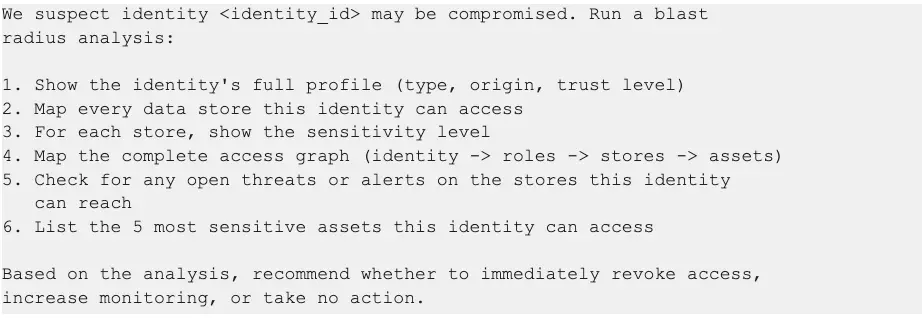
get_data_access_identities_by_id_graph -- Full access graph
threats_get_all_external -- Threats on accessible stores
alerts_get_all_external -- Alerts on accessible stores
get_data_access_identities_by_id_accessible_assets -- Top sensitive assets
Expected output: A risk-scored blast radius report with the identity's complete reach across the data estate, active threats in the blast zone, and a prioritized recommendation.
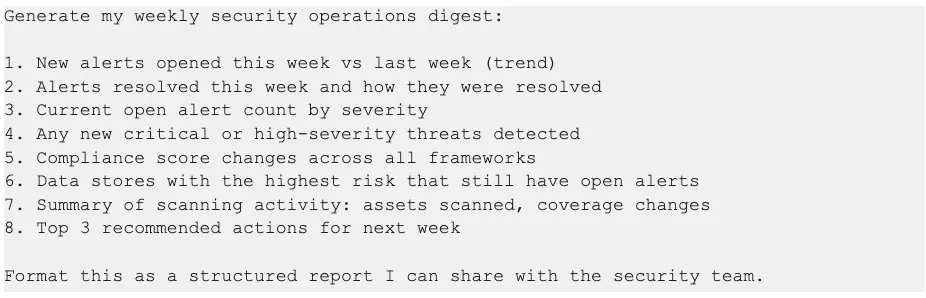
Expected output: A formatted weekly digest suitable for team distribution, with trend comparisons, prioritized actions, and metrics that track security operations performance.
Competitive Differentiation
Sentra vs. Read-Only Metadata MCP Servers
Dimension
Read-Only MCP Servers
Sentra MCP Server
Tool count
5–20 data catalog tools
130+ tools across 13+ domains
Operations
Read-only queries
Read + 11 write operations
Investigation depth
Single-tool lookups
Multi-step composite investigations
Guided workflows
None
5 pre-built security prompts
Security domains
Data catalog only
Alerts, threats, identity, compliance, DSAR, AI assets, policies, and more
1. Operational depth, not just observational breadth. The 11 write operations across 6 safety tiers transform the MCP server from a query interface into an operations platform. Security teams don't just find problems -- they fix them.
2. Composite investigation tools. The investigate_alert and security_posture_summary tools chain 5-6 API calls into single invocations. This isn't just convenience -- it reduces AI agent round trips, lowers latency, and keeps conversation context focused on analysis rather than data gathering.
3. Guided workflow prompts. Five pre-built prompts encode expert investigation methodologies directly into the MCP server. A junior analyst following the triage_alert prompt performs the same investigation as a senior engineer.
4. Full security domain coverage. From DSAR processing to AI asset risk assessment to MITRE ATT&CK threat mapping to identity graph traversal -- the Sentra MCP Server covers security operations end to end, not just the data catalog slice.
5. Enterprise-grade safety architecture. Write operations aren't an afterthought. The 6-tier hierarchy, feature flag gating, UUID validation, and explicit safety gates (like requiring confirm="PURGE" for destructive operations) ensure that conversational access doesn't compromise operational safety.
Security and Governance
The Sentra MCP Server is designed for enterprise security environments where the tools themselves must meet the same security standards as the data they protect.
Authentication and Authorization
Sentra API authentication via X-Sentra-API-Key header on all outbound API calls
MCP endpoint authentication via X-MCP-API-Key header for HTTP transport (prevents unauthorized agent connections)
API key permissions inherit from the Sentra platform -- the MCP server cannot exceed the privileges of the configured API key
Input Validation
UUID validation on all identifier parameters (alert_id, threat_id, policy_id, class_id) before HTTP calls are made
Input length limits on all string parameters (1000 chars for comments, 2000 chars for descriptions)
JSON schema validation for policy creation and tag updates
Enum validation for status transitions (only valid statuses and reasons accepted)
Network Security
SSRF protection blocks requests to private IP ranges (169.254.x, 10.x, 172.16-31.x, 192.168.x) and cloud metadata endpoints
HTTPS enforcement for all non-localhost connections
TLS-native deployment with certificate and key configuration for direct HTTPS serving
CORS controls with configurable origin allowlists for HTTP transport
Operational Safety
Feature flag gating (SENTRA_ENABLE_WRITE_OPS) enables or disables all write operations with a single environment variable
Team-shared instance, production security operations
Prerequisites
Python 3.11+ (or Docker)
Sentra API key with v3 access
Network access to your Sentra instance (typically https://app.sentra.io)
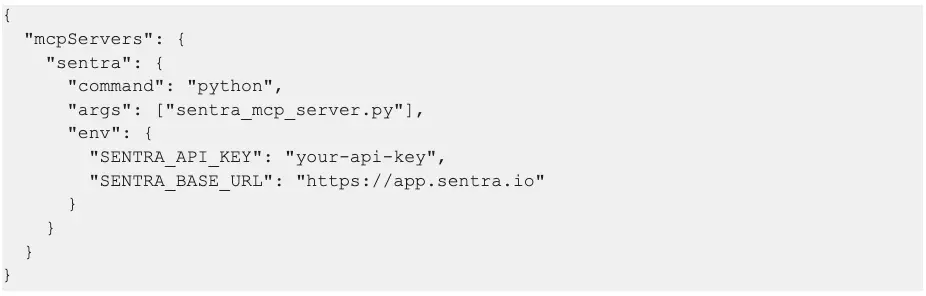
Quick Start (Claude Desktop)
Add to your Claude Desktop MCP configuration:
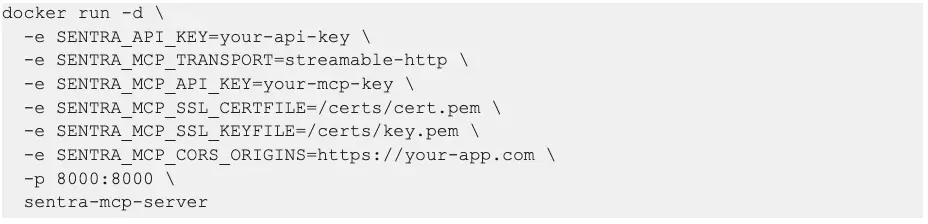
Production Deployment (Docker with TLS)
Configuration Reference
Environment Variable
Default
Description
SENTRA_API_KEY
(required)
Sentra API key for platform access
SENTRA_BASE_URL
https://app.sentra.io
Sentra API base URL
SENTRA_ENABLE_WRITE_OPS
true
Enable/disable all write operations
SENTRA_MCP_TRANSPORT
stdio
Transport mode: stdio, streamable-http, sse
SENTRA_MCP_API_KEY
(none)
API key required for HTTP transport authentication
SENTRA_MCP_HOST
0.0.0.0
HTTP transport bind address
SENTRA_MCP_PORT
8000
HTTP transport port
SENTRA_MCP_PATH
/mcp
HTTP transport endpoint path
SENTRA_MCP_SSL_CERTFILE
(none)
TLS certificate file path
SENTRA_MCP_SSL_KEYFILE
(none)
TLS private key file path
SENTRA_MCP_CORS_ORIGINS
(none)
Comma-separated allowed CORS origins
SENTRA_MCP_MODE
full
full (all tools) or cursor (priority subset)
Call to Action
For Existing Sentra Customers
The MCP server is available today. Deploy it alongside your existing Sentra instance and start using natural language to investigate alerts, prepare compliance reports, and manage security operations. Contact your Sentra account team for deployment guidance and best practices.
For Security Teams Evaluating DSPM
The Sentra MCP Server demonstrates what modern data security operations look like: conversational, automated, and end-to-end. Request a demo to see how AI-driven security operations can reduce alert triage time, accelerate compliance preparation, and close the gap from detection to response.
For Security Engineers
The MCP server is open for customization. Add your own tools, create custom prompts that encode your organization's investigation methodologies, and integrate with your existing security workflows. The architecture is designed for extensibility -- every tool registered through the OpenAPI spec is automatically available, and custom tools can be added alongside the auto-generated ones.
The future of data security operations is conversational. Investigate, triage, and resolve -- not just query.
Amazon S3 is one of the most widely used cloud storage services in the world, and with that scale comes real security responsibility. Misconfigured buckets remain a leading cause of sensitive data exposure in cloud environments, from accidentally public objects to overly permissive policies that go unnoticed for months. Whether you're hosting static assets, storing application data, or archiving compliance records, getting S3 bucket security right is not optional. This guide covers foundational defaults, policy configurations, and practical checklists to give you an actionable reference as of early 2026.
How S3 Bucket Security Works by Default
A common misconception is that S3 buckets are inherently risky. In reality, all S3 buckets are private by default. When you create a new bucket, no public access is granted, and AWS automatically enables Block Public Access settings at the account level.
Access is governed by a layered permission model where an explicit Deny always overrides an Allow, regardless of where it's defined. Understanding this hierarchy is the foundation of any secure configuration:
IAM identity-based policies, control what actions a user or role can perform
Bucket resource-based policies, define who can access a specific bucket and under what conditions
Access Control Lists (ACLs), legacy object-level permissions (AWS now recommends disabling these entirely)
VPC endpoint policies, restrict which buckets and actions are reachable from within a VPC
AWS recommends setting S3 Object Ownership to "bucket owner enforced," which disables ACLs. This simplifies permission management significantly, instead of managing object-level ACLs across millions of objects, all access flows through bucket policies and IAM, which are far easier to audit.
AWS S3 Security Best Practices
A defense-in-depth approach means layering multiple controls rather than relying on any single setting. Here is the current AWS-recommended baseline:
Practice
Details
Block public access
Enable S3 Block Public Access at both bucket and account levels. Enforce via Service Control Policies (SCPs) in AWS Organizations.
Least-privilege IAM
Grant only specific actions each role needs. Avoid "Action": "s3:*" in production. Use presigned URLs for temporary access. Learn more about AWS IAM.
Encrypt at rest and in transit
Configure default SSE-S3 or SSE-KMS encryption. Enforce HTTPS by denying requests where aws:SecureTransport is false.
Enable versioning & Object Lock
Versioning preserves object history for recovery. Object Lock enforces WORM for compliance-critical data.
Unpredictable bucket names
Append a GUID or random identifier to reduce risk of bucket squatting.
VPC endpoints
Route internal workload traffic through VPC endpoints so it never traverses the public internet.
S3 Bucket Policy Examples for Common Security Scenarios
Bucket policies are JSON documents attached directly to a bucket that define who can access it and under what conditions. Below are the most practically useful examples.
Restrict to a specific VPC endpoint: Use the aws:sourceVpce condition key to ensure the bucket is only reachable from a designated private network.
Grant CloudFront OAI access: Allow only the Origin Access Identity principal, keeping objects private from direct URL access while serving them through the CDN.
IP-based restrictions: Use NotIpAddress with aws:SourceIp to deny requests from outside a trusted CIDR range.
Always use "Version": "2012-10-17" and validate policies through IAM Access Analyzer before deployment to catch unintended access grants.
Enforcing SSL with the s3-bucket-ssl-requests-only Policy
Forcing all S3 traffic over HTTPS is one of the most straightforward, high-impact controls available. The AWS Config managed rule s3-bucket-ssl-requests-only checks whether your bucket policy explicitly denies HTTP requests, flagging non-compliant buckets automatically.
The policy evaluates the aws:SecureTransport condition key. When a request arrives over plain HTTP, this key evaluates to false, and the Deny statement blocks it. This applies to all principals, AWS services, cross-account roles, and anonymous requests alike. Adding the HTTPS-only Deny statement shown in the policy examples section above satisfies both the AWS Config rule and common compliance requirements under PCI-DSS and HIPAA.
Using an S3 Bucket Policy Generator Safely
The AWS Policy Generator is a useful starting point, but generated policies require careful review before going into production. Follow these steps:
Select "S3 Bucket Policy" as the policy type, then fill in the principal, actions, resource ARN, and conditions (e.g., aws:SecureTransport or aws:SourceIp).
Check for overly broad principals, avoid "Principal": "*" unless intentional.
Verify resource ARNs are scoped correctly (bucket-level vs. object-level).
Use IAM Access Analyzer's "Preview external access" feature to understand the real-world effect before saving.
The generator is a scaffold, security judgment still applies. Never paste generated JSON directly into production without review.
S3 Bucket Security Checklist
Use this consolidated checklist to audit any S3 bucket configuration:
Control
Status
Block Public Access
Enabled at account and bucket level
ACLs disabled
Object Ownership set to "bucket owner enforced"
Default encryption
SSE-S3 or SSE-KMS configured
HTTPS enforced
Bucket policy denies aws:SecureTransport: false
Least-privilege IAM
No wildcard actions in production policies
Versioning
Enabled; Object Lock for sensitive data
Bucket naming
Includes unpredictable identifiers
VPC endpoints
Configured for internal workloads
Logging & monitoring
Server access logging, CloudTrail, GuardDuty, and IAM Access Analyzer active
AWS Config rules
s3-bucket-ssl-requests-only and related rules enabled
Disaster recovery
Cross-region replication configured where required
How Sentra Strengthens S3 Bucket Security at Scale
Applying the right bucket policies and IAM controls is necessary, but at enterprise scale, knowing which buckets contain sensitive data, how that data moves, and who can access it becomes the harder problem. This is where cloud data exposure typically occurs: not from a single misconfigured bucket, but from data sprawl across hundreds of buckets that no one has a complete picture of.
Sentra discovers and classifies sensitive data at petabyte scale directly within your environment, data never leaves your control. It maps data movement across S3, identifies shadow data and over-permissioned buckets, and enforces data-driven guardrails aligned with compliance requirements. For organizations adopting AI, Sentra provides the visibility needed to ensure sensitive training data or model outputs in S3 are properly governed. Eliminating redundant and orphaned data typically reduces cloud storage costs by around 20%.
S3 bucket security is not a one-time configuration task. It's an ongoing practice spanning access control, encryption, network boundaries, monitoring, and data visibility. The controls covered here, from enforcing SSL and disabling ACLs to using policy generators safely and maintaining a security checklist, give you a comprehensive framework. As your environment grows, pairing these technical controls with continuous data discovery ensures your security posture scales with your data, not behind it.
Read More
Expert Data Security Insights Straight to Your Inbox
What Should I Do Now:
1
Get the latest GigaOm DSPM Radar report - see why Sentra was named a Leader and Fast Mover in data security. Download now and stay ahead on securing sensitive data.
2
Sign up for a demo and learn how Sentra’s data security platform can uncover hidden risks, simplify compliance, and safeguard your sensitive data.
3
Follow us on LinkedIn, X (Twitter), and YouTube for actionable expert insights on how to strengthen your data security, build a successful DSPM program, and more!
Before you go...
Get the Gartner Customers' Choice for DSPM Report
Read why 98% of users recommend Sentra.
This website uses cookies to improve your experience and provide personalized services. See our Privacy Policy and Cookie Policy. We won't track your information unless you accept.